Behind the
Ice Wall
A Chronicle of Discovery and the Unknown
In the reading rooms of the Royal Archive, restorer Adrian Hale finds what three centuries of scholars missed — a single line, scraped from a map and almost perfectly erased. It leads him past the edge of every known chart, toward a wall of ice that isn't supposed to exist, and the world it was built to hide.
- Available on Amazon Kindle
- Paperback Coming Soon
- Instant Digital Download
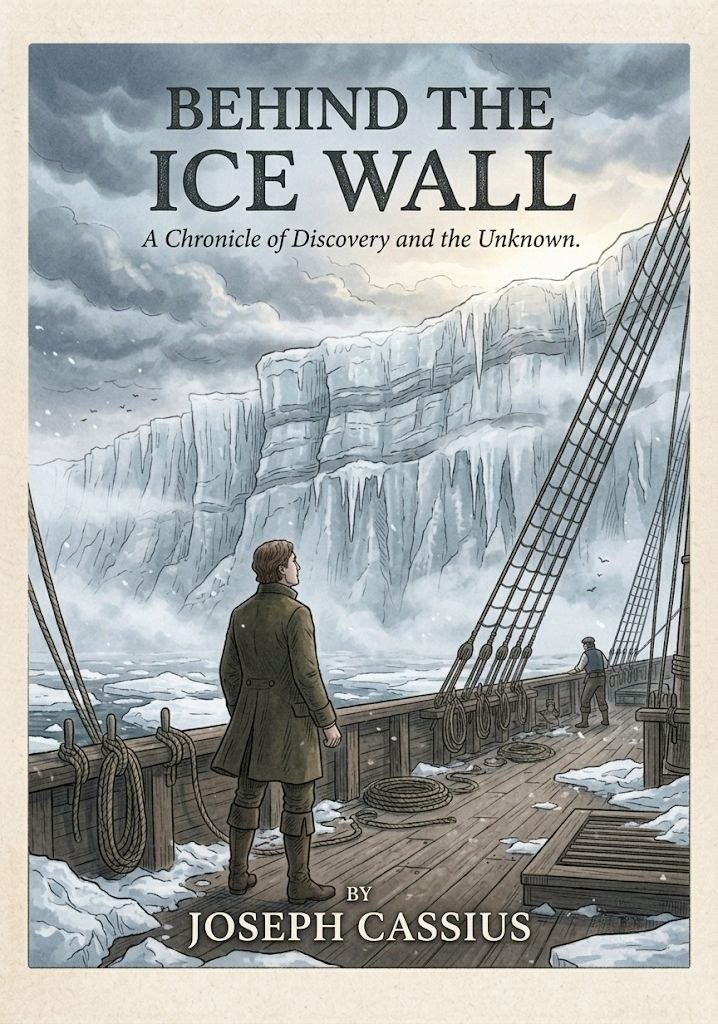
Four reasons this map won't stay buried.
A Line That Shouldn't Exist
On a chart two centuries old, one restorer notices a single crooked stroke — and uncovers a secret the kingdom spent generations trying to bury.
A Hundred Feet of Ice
The Terror sails north until the charts run out, toward a hundred-foot wall of ice no official record admits is there.
An Empire Built on Erasure
A quiet office in the capital has spent generations turning inconvenient places into blank space on a map — and silencing the witnesses who refuse to forget them.
1845. A World Not as Mapped as It Claims.
A slow-burn mystery of archives and forgeries, and the danger of refusing to look away from a contradiction.
Chapter One — The Forgotten Map
Read exactly as it appears in the paperback, straight from the Royal Archive.
Chapter One
The Forgotten Map
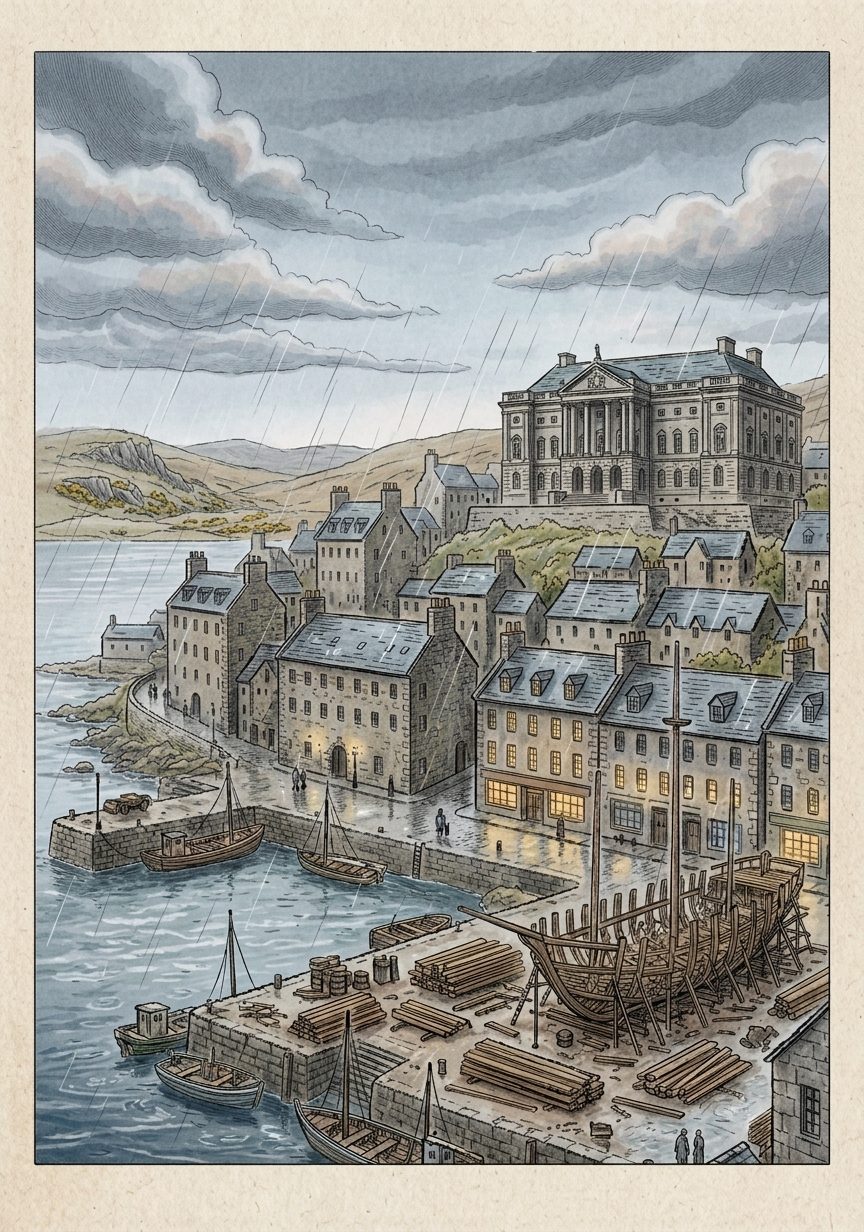
Rain drifted across the harbor city of Harrowport in long silver veils, softening the outlines of the ships anchored beyond the docks and turning the slate rooftops into dull mirrors that reflected the pale morning sky. It was the kind of rain the city knew best—not a storm, but a patient, settling wet that had been falling since before dawn and would go on falling long after dark, beading on the rigging of the merchantmen, running in the gutters of the fish market, blurring the yellow lamps that still burned in the counting-houses along the quay. Harrowport was a city built on the sea’s business and the sea’s weather, and it wore both without complaint.
Above it all, on the highest ground the city possessed, the Royal Archive overlooked the waterfront like a second, sterner cathedral. Its granite walls had been weathered by centuries of salt wind and winter storms until the stone had gone the color of old pewter, and its narrow windows, set deep to keep out the damp, watched the harbor with the flat patience of something that had outlived every ship it had ever seen come in. Within its vast reading halls, silence was observed with almost religious devotion, broken only by the turning of pages, the scratch of pen against paper, and the distant creak of ladders sliding along shelves that reached toward the vaulted ceiling. The Archive held the memory of a kingdom—its treaties, its accounts, its surveys, its lies—and it held them in a quiet so deep that newcomers often lowered their voices for a week before they understood why.
Adrian Hale had spent nearly a decade inside those halls, yet he had never grown accustomed to the feeling that the building itself was listening. Every corridor carried echoes of forgotten conversations, and every cabinet concealed records that had outlived kingdoms, wars, and generations of scholars who believed they had extracted every useful truth from them. Most visitors came to the Archive seeking answers to questions they already half knew. Adrian had learned, over ten patient years, that the more interesting discoveries usually began somewhere else entirely—not with an answer, but with a contradiction; not with a thing that was present, but with the faint, telltale shape of a thing that should have been present and was not.
He was not, by temperament, a man who chased marvels. He had come to the Archive as an orphan of a shipwright’s family, taken on first to sweep the reading rooms and carry coal, and later—when an under-keeper named Mercer noticed that the sweeping-boy had been correcting the catalog in its margins in a small, exact hand—to learn the slow trade of restoration and record. He had made himself indispensable the only way an outsider ever could: by being right, patiently and repeatedly, about small things, until he was trusted with large ones. He distrusted enthusiasm, in others and most of all in himself. A discovery that could not survive a second look was not a discovery. It was a wish wearing a discovery’s coat, and Adrian had watched wishes ruin better scholars than himself.
Not everyone in the Archive loved him for it. Careful men make careless men nervous, and there was no man in the building more nervous, or more careful to hide it, than Julian Keeler.
Keeler was a sub-keeper of the second rank, a decade older than Adrian and a decade more ambitious, with soft hands and a memory for the names of important people. He had entered the Archive through the front door, with a family behind him and a letter of introduction, and it galled him beyond expression that the shipwright’s orphan who had entered through the coal cellar was the one the senior keepers sent for when a document would not give up its secret. That morning Keeler paused at the door of the northern map room, as he often did, on the pretext of some errand.
“Still at the old northern surveys, Hale?” he said, in the tone of a man who has decided to be amused. “The most catalogued charts in the collection. Restored twice. Cited in every history worth the name. One might almost think you enjoyed proving that there is nothing left to find.”
“One might,” Adrian agreed, without looking up.
“The senior keepers were asking after your progress.” Keeler let the words hang. “It would be a pity if a man of your gifts spent his best years polishing what everyone already knows.” He smiled, the way a man smiles when he has said something he hopes will wound and cannot be called unkind. “Do send word if you unearth anything the rest of us have somehow overlooked.”
“I always do,” Adrian said, and turned the lamp a fraction, and waited for the door to close.
When it had, he let out a slow breath and returned to the chart.
It lay spread across the oak table before him, weighted flat at its corners with small leather bags of shot: a seventeenth-century survey of the northern ocean, remarkable only for its reputation as one of the most thoroughly studied maps in the Archive. It had been catalogued repeatedly, restored with meticulous care, and cited in countless histories. According to every official record, there was nothing left to learn from it. Keeler was right about that much. That was precisely why Adrian was looking at it.
For there was a small wrongness in the chart, and it had been troubling him for three days—not in the coastlines, which were as familiar to him as the streets of the city below, but in the balance of the thing, the way the eye traveled across it. He could not yet have said what was wrong. He only knew the feeling, which he had learned to trust: the sense a restorer develops after long years, the way a physician learns to feel a wrongness in a pulse before he can name the disease.
Rather than examining the coastlines or the decorative illustrations, he directed the beam of a brass lamp across the parchment at a shallow angle. Experience had taught him that ink could be altered, scraped away, or replaced, but that the fibers beneath retained subtle scars no restorer, however skilled, could completely erase. Paper remembered. It remembered the press of a nib, the drag of a knife, the ghost of a line that had been washed away a century before. He adjusted the lamp by the smallest degree and watched the surface. For several moments nothing happened. The rain ticked at the window. Somewhere below, a ship’s bell rang the hour and was answered by another.
Then, just as he was about to move the chart again, a faint blue curve shimmered beneath the faded paint before vanishing back into the texture of the parchment.
Adrian went very still.
He moved the lamp again, slowly, hunting the angle, and there it was once more—a single arc of pale blue, fine as a hair, running through the empty northern quarter of the map where there was nothing to draw and no reason to have drawn it. It did not belong to any coastline. It did not belong to the compass roses or the decorative winds. It was a line someone had made and someone else had taken great pains to remove, and the parchment, faithful as an old servant, had kept the secret of it against the day a lamp was held at exactly the right angle.
He opened his notebook and wrote a single sentence in careful handwriting. Observation: evidence of an erased geometric feature beneath the northern projection. Nature unknown. Verification required. He closed the notebook without adding another word.
Whatever he had found, it was not yet a discovery. It was merely the beginning of an investigation, and Adrian had ruined more than one promising theory by falling in love with it before it had been made to earn his trust.
From the cabinet beneath the table he removed three later editions of the same survey. Though produced decades apart by different royal cartographers, they appeared almost identical to the untrained eye—the same coast, the same soundings, the same careful decorations. Adrian ignored all of it. Instead he aligned the faint projection grids that bordered each map, the fine web of latitude and longitude on which every coastline is hung, and began comparing not geography but measurement.
The work was painstaking, demanding the patience of a surveyor rather than the curiosity of a historian. He set the dividers, walked them across the graticule, recorded the figure, and did it again on the next edition, and the next. An hour passed. The lamp needed trimming. He trimmed it and went on. And within that hour a pattern emerged from the numbers the way a shape emerges from fog—slowly, and then all at once, and then impossible to un-see. The coast remained remarkably consistent across every edition. But the geometry beneath it did not. From one generation of the survey to the next, the northern graticule had crept—shifted north by an amount so small that no ordinary navigator would ever notice it, yet so precise, so consistent in its direction, that chance alone could not explain it.
He checked the figures again, then a third time, changing both the ruler and the measuring compass to rule out any fault in his instruments. Every calculation produced the same result. Someone had preserved the appearance of the map, faithfully, lovingly, across a century—while quietly altering the mathematical framework upon which the whole of it was built.
Adrian sat back, and for a moment the enormity of it kept him from moving.
It was an elegant deception. That was what struck him first, before the fear—the sheer craftsmanship of it. A sailor could take these charts and cross the known seas his whole life without the least difficulty, never once suspecting that the coordinates beneath his coast had been shifted beneath him a hair’s breadth at a time. Only someone perverse enough to compare four generations of the same map, line by line and measurement by measurement, would ever notice that the world under the ink had moved. Whoever had done this had not been hiding a coastline. Coastlines are easy to hide; you simply do not draw them. This was subtler and far more disturbing. Whoever had done this had been hiding a route—bending the reference frame of the entire northern ocean by a few degrees, so that any ship steering by the honest, published coordinates would arrive a little to the west of wherever the blue line led, and find nothing there, and go home certain.
He rested both hands on the table and allowed himself a slow breath. The temptation to call it proof was strong. But years of archival work had taught him that confidence was not evidence, that every remarkable discovery began as a possibility, and that a great many of them ended as ordinary mistakes wearing a marvelous disguise. If the anomaly was genuine, it would have left a wake. Deceptions, like ships, disturb the water they pass through. He would find the wake, or he would abandon the theory.
He returned the charts to their proper order and opened a fresh page. Across the top he wrote a new heading—Independent Verification Required—and beneath it listed the documents he would need: earlier survey editions, restoration records, navigational logs, and the acquisition registers dating back before the Year of Ash. If the geometry had truly been altered, the alteration would have needed a source: a document that had been removed, a survey that had been quietly reclassified, a hole in the record where the truth had once been. History rarely erased itself completely. It simply became more difficult to read.
The catalog cabinets lined the eastern wall of the map room, their narrow drawers labeled in faded brass that recorded nearly two centuries of revisions. Most researchers approached them alphabetically, trusting the order imposed by generations of archivists. Adrian trusted the catalog for the opposite reason: because order, when it has been disturbed, cannot fully hide the disturbance. If something had been removed, the absence usually left a shape behind it—a gap in a sequence, a card in the wrong hand, two records that should never have been neighbors sitting suddenly side by side.
He began with the drawers marked Maritime Acquisitions and worked backward by date rather than by name. The first ledgers held what he expected—restored charts, provincial donations, duplicated atlases, and correspondence from ports that had long since lost their importance. Then, midway through a ledger from the Year of Ash, the numbering skipped. One entry was gone entirely, leaving two records that should never have touched sitting directly beside each other. He checked the neighboring cards, the borrowing slips, the restoration tags. Nothing had been misfiled. The gap was not an accident of the pen. It was deliberate, and it was old.
He copied the surrounding references and opened the next drawer. Another omission waited there, smaller but no less precise, and beside it a note in a later hand: Transferred by directive. The handwriting was neat, almost indifferent, as though whoever wrote it had expected the instruction to explain everything and had not troubled to imagine a reader who would question it. Adrian lifted the card to the light. Pressed so faintly into the lower margin that it might have gone unnoticed for a century was a mark he had already seen once that morning, without knowing it for what it was—a compass rose divided by a single vertical line, a meridian drawn straight through its heart.
It was not a library stamp. He knew every mark the Archive used, and this was none of them. It was a seal.
He was still studying it when he became aware that he was no longer alone, and that he had not heard the door.
Professor Mercer had crossed the reading room and come to stand at his shoulder. He was an old man now, tall and stooped, with ink worked so deeply into the knuckles of his right hand that no amount of washing had ever taken it out. He had been the under-keeper who noticed a sweeping-boy correcting the catalog thirty years before; he had taught Adrian everything the Archive could teach, and a good deal that it could not, and he was the nearest thing to family that Adrian had ever allowed himself to keep. He had not spoken. But his expression had changed in the subtle way that meant he had already seen the thing Adrian had found, and had, perhaps, been waiting a very long time for someone to find it.
“This isn’t a mistake,” Adrian said.
“No,” Mercer answered. “It isn’t.”
Adrian looked up at him. “You knew that already.”
Mercer’s gaze stayed on the drawer rather than the card. “I suspected. For a long time, I suspected. I did not want to say more until you had something you could hold in your hand—something that did not depend on the word of a frightened old man.”
“And now?”
“Now,” Mercer said quietly, “you have a reason to keep looking. And I have a reason to be afraid for you, which is a different thing, and I would ask you to forgive me for both.”
That was enough for the moment. Adrian turned the card over beneath the lamp. The ink of the note belonged to a later generation than the ledger, but the pressure of the pen had left impressions that extended past the writing itself—the ghost of a line beneath the visible one. He tilted the light until the surface caught the glow at a shallow angle, the same trick that had given up the blue curve, and beneath the words Transferred by directive he could just make out the beginning of another line that had been scraped away. Three letters, no more. The start of a word that had not survived.
He reached for a sheet of tracing vellum and copied what remained, working by pressure rather than ink, the way he had restored a hundred damaged manuscripts. Even when the words were gone, the fibers remembered.
A voyage from a quiet archive to the edge of the map.
Behind the Ice Wall follows one journey in six stages — from a rain-soaked reading room to a country the world was taught to forget. Here's the shape of the voyage, without the spoilers.
-
Chapters One–Two
Harrowport
A decade-long archive restorer finds a single erased line on a map two centuries old — and someone starts following him through the rain.
-
Chapter Three
Into the Northern Sea
Adrian charms his way onto the Terror's manifest, and Captain Sela Torin sails north — past the last chart either of them can trust.
-
Chapter Four
The Ice Wall
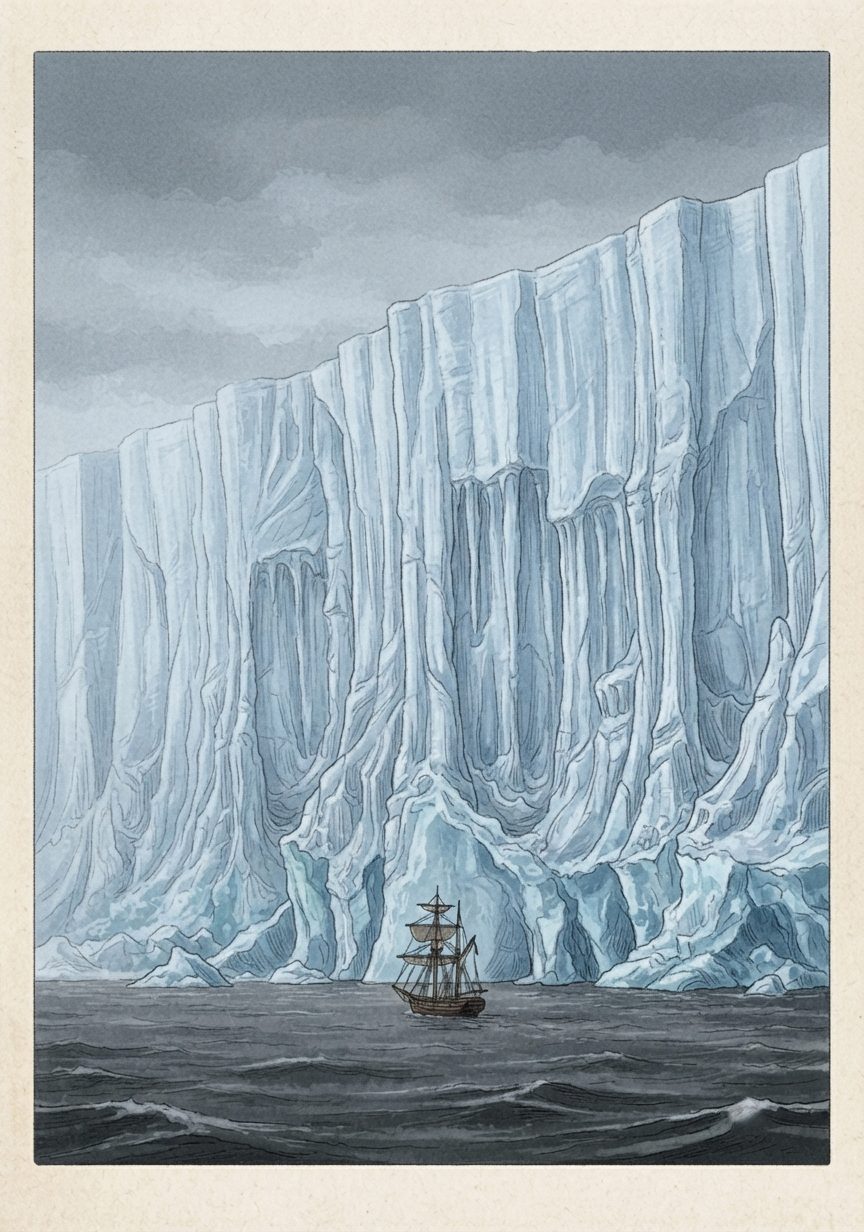
A wall of ice rises a hundred feet from the sea ahead of them — unmarked on any official map, exactly where the erased line said it would be.
-
Chapter Five
The Forgotten Lands
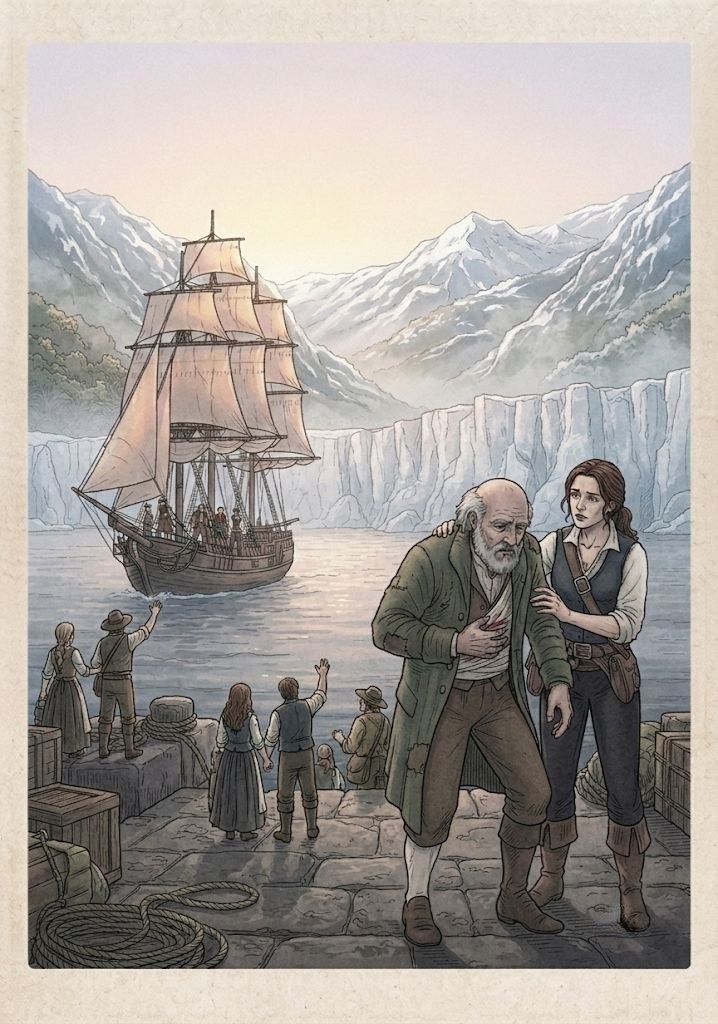
Beyond the wall: a warm, green country that was never lost. Only hidden — and guarded.
-
Chapter Six
The Wardens
The people who have kept Merenhal's long watch for three centuries must decide whether strangers can be trusted with a secret this old.
-
Chapter Seven & Epilogue
The Honest Map
Back in Harrowport, Adrian faces the office that erased a country — and finishes the map it spent three hundred years trying to prevent.
Six stages. One vanished country. A map put right.
Begin the voyage — get the bookA kingdom's most trusted maps were never entirely honest.
Harrowport, 1845. Adrian Hale has spent a decade restoring the kingdom's oldest charts inside the granite walls of the Royal Archive — patient work, unglamorous work, the kind that teaches a man to trust a contradiction over a comfortable answer. When his lamp catches a single erased curve on a map that scholars have studied for two hundred years, he assumes it's an old surveyor's mistake.
It is not a mistake. It is a crime three centuries in the making — a green country scraped from every chart in the realm by an office that has made an art of unmaking places, and the people who remember them, one careful correction at a time.
Pursued through Harrowport's rain-slick streets, guided by an old keeper's forbidden notebook, Adrian talks his way aboard the Terror and sails north with Captain Sela Torin, toward a towering wall of ice that no chart still in circulation dares to mark.
What waits behind it was never lost. It was hidden — and the difference between the two is the entire, dangerous heart of this book.
Scenes from the novel.
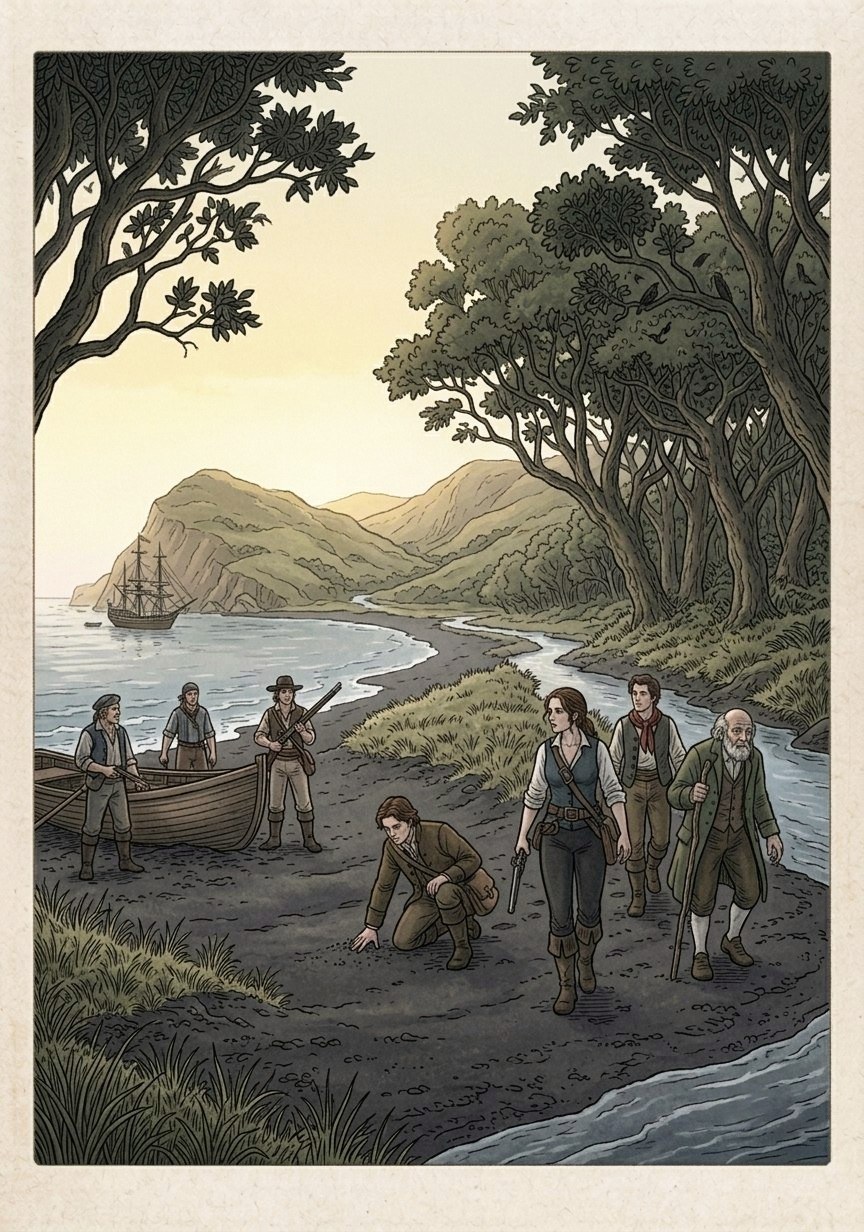
Seven chapters. One vanished country.
A restorer, a captain, and the archive that watches them both.
Adrian Hale
The Restorer
An archive-keeper's orphan raised inside the Royal Archive, Adrian has spent nearly ten years there as a restorer — exacting, unglamorous work that rewards patience over instinct. He's skeptical by nature, the kind of scholar who needs to see a thing twice before he'll believe it once. That same caution is what stops him cold when a mark on an old chart refuses to explain itself away.
Sela Torin
The Captain
Master of the Terror, and one of the few captains left willing to sail past where the honest charts end. Sela has spent her career navigating the gap between what the official maps say and what the sea actually shows her. She agrees to carry a restorer and his impossible request north — not out of curiosity, but because she's long suspected the charts were lying to her too.
Julian Keeler
The Rival
A sub-keeper at the Royal Archive with soft hands, a good name, and a talent for being underestimated. He has spent years quietly positioning himself to inherit Adrian's post, and doesn't appreciate the competition. A discovery this large, credited to someone else, is exactly the kind of complication Julian has built his career around avoiding.
Mercer
The Old Keeper
Thirty years a keeper himself, now living quietly above a chandler's shop with a debt he means to finally pay. Mercer is the one who hands Adrian the notebook that shouldn't exist — pages of careful, forbidden notes kept by someone who watched the erasures begin and couldn't stop them, only record them. What he knows could bring the whole quiet business of forgetting crashing down. What it costs him to share it is the reason he waited thirty years.
Everything you need to start reading tonight.
Instant Download
Get the full PDF immediately after checkout — no waiting, no shipping.
Complete Novel
Seven full chapters plus an epilogue — the entire story, start to finish.
~100 Pages
A satisfying, unhurried read — long enough to get lost in, short enough for a weekend.
Free Sample Chapter
Read all of Chapter One free, right on this page, before you decide.
Read on Any Device
Delivered as a PDF — open it on your phone, tablet, e-reader, or computer.
Author's Note Included
Joseph Cassius on the real question behind the story — plus acknowledgements.
For readers who want their adventure with a little ink under its fingernails.
Why readers enjoy this book.
Historical Mystery
A forged map and a buried secret pull a decade-long archive restorer into a two-hundred-year-old contradiction he can't look away from.
Exploration
A voyage past the edge of every honest chart, aboard a ship willing to sail where the official maps refuse to go.
Lost Civilizations
A green country hidden behind a hundred feet of ice, and the people who have quietly guarded it for three centuries.
Adventure
Rain-slick chases, a forbidden notebook, and a restorer talking his way onto a ship he has no business boarding.
Ancient Maps
Two centuries of careful erasures and corrections, undone by one crooked stroke that refuses to stay hidden.
Secrets Beyond the Known World
What waits behind the wall was never lost — only hidden. The difference between the two is the entire point.
Frequently asked questions.
Is this fiction?
Yes. Behind the Ice Wall is a work of historical adventure fiction — Adrian Hale, the Royal Archive, and the world beyond the ice wall are all invented for the story.
What format is the book in?
Behind the Ice Wall is delivered as a downloadable PDF, so you can read it on your phone, tablet, e-reader, or computer.
Which formats are available?
Three ways to read it: a digital PDF download via Gumroad, a Kindle eBook on Amazon, and soon a paperback on Amazon as well.
Is the paperback printed in color?
The paperback has a full-color cover with black-and-white interior text, standard for a novel like this.
Can I read it on any Kindle app?
Yes — the free Kindle app is available for iOS, Android, Mac, and PC, plus any Kindle e-reader, so you can read on whichever device you already own.
How long is the book?
Seven chapters plus an epilogue — about 100 pages, a satisfying weekend read.
Can I read a sample before buying?
Yes — the complete text of Chapter One is free to read on this page. Use the "Read Chapter One" button near the top, or the link above.
Is this the complete novel?
Yes. Your purchase includes the full novel from Chapter One through the Epilogue, plus the author's note and acknowledgements.
How do I receive my purchase?
Gumroad emails you a download link immediately after checkout, and you can re-download the file anytime from your Gumroad library.
Is it available worldwide?
The Gumroad PDF is available anywhere with an internet connection. The Kindle edition is available in every country Amazon serves; paperback availability will depend on your local Amazon marketplace once that edition goes live.
Do you offer refunds?
Purchases are handled through Gumroad's standard policies. If anything's wrong with your order, reply to your Gumroad receipt email and it'll be sorted out.
What readers are saying.
Behind the Ice Wall
A slow-burn historical adventure of forged maps, buried secrets, and the country they were built to hide — by Joseph Cassius.
Not sure yet? Read Chapter One free →Buy on Amazon
Prefer Amazon? Behind the Ice Wall is also available there — read instantly on Kindle, with the paperback edition on its way.
Kindle Edition
Read instantly with the free Kindle app on any phone, tablet, or e-reader.
Paperback Edition
The full print edition, delivered to your door by Amazon.